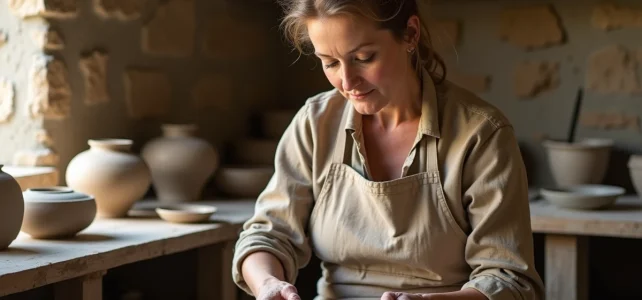
Seven out of ten residents is not a figure we often hear when it comes to a shared passion. In Saint-Amand-en-Puisaye, ceramics are not just a profession: they are a common story, a thread stretched between generations, which has withstood industrial waves and fleeting trends. Here, pottery shapes lives as much as the earth itself. Few professions can boast such human density and such a strong anchoring.
What strikes is not only the continuity of tradition but also how these villages have built their identity well beyond a market logic or mere proximity to clay quarries. Every year, enthusiasts flock to see up close what happens to the earth when the hand of man intervenes and the gesture takes precedence over the machine.
You may also like : Exploring the Different Spheres of Personal and Professional Development for Growth
Why do pottery villages embody the soul of French ceramics?
The strength of French artisan ceramics is not limited to the richness of its raw materials or the quality of its clay soils. It asserts itself in the pottery villages, where each gesture carries the weight of a family history, where the know-how is passed down without interruption, from the parent’s hand to the child’s. Here, cultural heritage is not a fixed concept: it is embodied in the precise gestures and attentive gazes of artisans who live their craft as an obviousness. In these towns nestled away from hurried eyes, the concentration of craft professions has no equivalent in the country. Each pottery piece that comes out of the kiln tells as much the story of a village as that of its inhabitants.
At the center of these villages, ceramics are a matter of community. The sharing of knowledge, the transmission of techniques, all this plays out both in the intimacy of the workshop and in the public square. Here, one finds a living geography of French heritage, from the block of clay to the finished object. Tradition, here, is never a hindrance: it absorbs influences, welcomes new practices, without ever betraying the received legacy.
You may also like : Travel Differently: Explore the Most Beautiful Landscapes and Cultures in the World
The very existence of these villages owes much to the presence of clay: artisans settled where the earth offered its qualities, but they have managed to create much more than a simple resource exploitation. In every kiln, every potter’s wheel, resonates this alliance between nature and technique, patience and demand.
To approach this reality, discovering the Orvinfait site, a curious and offbeat magazine, allows one to grasp the vitality of the pottery villages and the diversity of artisan potteries in France. Here, ceramics speak, telling the fidelity to creation and transmission, far from impersonal series.
Meeting the emblematic villages: traditions, workshops, and unique know-how
In northern Burgundy, Saint-Amand-en-Puisaye stands out as the flagship of artisan pottery. Marked by the weight of the Middle Ages, this village lives to the rhythm of working the land. The potter artisans repeat the gestures learned from their elders, constantly adjusting the dialogue between ancestral knowledge and creativity. Each workshop carries the memory of a place, a family, and each ceramic piece retains the unique trace of a living transmission.
What distinguishes Puisaye is the diversity of its creations and the visceral attachment of its potters to their history. The local clay, malleable and generous, serves as a backdrop for each person’s expression, whether shaping everyday objects or signing works of ceramic art. The alleys bring together ancient kilns and showcases where bowls, plates, vases, utility, or decorative pieces align. Some workshops open their doors to those who wish to observe, revealing the precision needed at each stage.
To better understand what makes these places unique, here are a few landmarks:
- In Saint-Amand-en-Puisaye, tradition and contemporary creation intertwine to shape a singular identity.
- The pottery villages of Burgundy allow one to dive into a dynamic heritage, where human hands maintain their preeminence.
- The transmission of the craft, from shaping to firing, irrigates every corner of the village, a living laboratory of French pottery.
Burgundy thus remains a favored territory for ceramics enthusiasts, where heritage is reinvented every day in contact with today’s uses and forms.

Preparing your visit: practical tips to discover local craftsmanship and experience authenticity
Nothing replaces the on-site discovery: wandering through the villages, stopping in front of an active kiln, or pushing open the door of a workshop is where artisan ceramics truly makes sense. During potters’ markets or seasonal exhibitions, spring and summer offer an ideal opportunity to grasp the richness of both contemporary creation and traditional pieces.
Meeting the artisans in their environment means observing the earth transform under their fingers, following the journey of a unique piece from shaping to firing, and feeling how each step matters in the transmission of know-how. Several villages open their doors to those who wish to get hands-on: pottery classes are offered for those wanting to learn shaping, discover the subtleties of the wheel, or understand the secrets of firing.
Here’s how to make the most of your visit:
- Pay attention to the artisan houses, often marked at the entrance of the village by a distinctive symbol.
- Feel free to discuss with the potters about local raw materials, clay soil, their journeys, inspirations, and the evolutions of their ceramic work.
- Take the time to discover the variety of decorative objects and table arts displayed in each workshop.
Acquiring a piece means bringing home much more than an object: it is introducing a living fragment of cultural heritage into daily life. Like a hand reaching out between the past and the future, French ceramics are tamed through encounters, far from the beaten paths. The magic operates, discreet and tenacious, for those who know how to look for it.