
A brushcutter is not chosen like a lawnmower. The engine displacement, the type of cutting head, and the weight/torque ratio directly affect the quality of work and fatigue at the end of a session. We review the technical points that make the difference between a relevant purchase and an undersized tool for your garden.
Multi-line cutting heads and anti-rebound blades: what changes in private gardens
Consumer articles often pit “line or blade” against each other without going further. For a few seasons now, manufacturers and accessory suppliers have been offering multi-line heads and specific anti-rebound blades that radically change the game in family gardens.
Recommended read : How to Choose a Pool Heating Cover and Optimize Water Temperature
A multi-line head (three or four strands) distributes the cutting effort over several contact points. The result: fewer gravel projections along walls, fences, and pedestrian areas. For a garden where children play regularly, reducing projections is just as important as power.
Anti-rebound blades, on the other hand, limit violent shocks when the disk encounters a hard obstacle (flush stump, concrete edge). In a periodically maintained area, where hidden obstacles under vegetation are common, this type of blade prevents premature wear of the angle gearbox and protects the operator. We recommend checking the compatibility of these accessories with your machine before purchase, as not all brands use the same mounting standard.
Related reading : How to Identify the Owner of a Mobile Number for Free: Effective Tips
You will find a wide selection of compatible machines and accessories at debroussailleuse-warrior.com, with detailed sheets outlining the types of heads accepted by each model.
Gas or battery brushcutter: deciding based on noise constraints
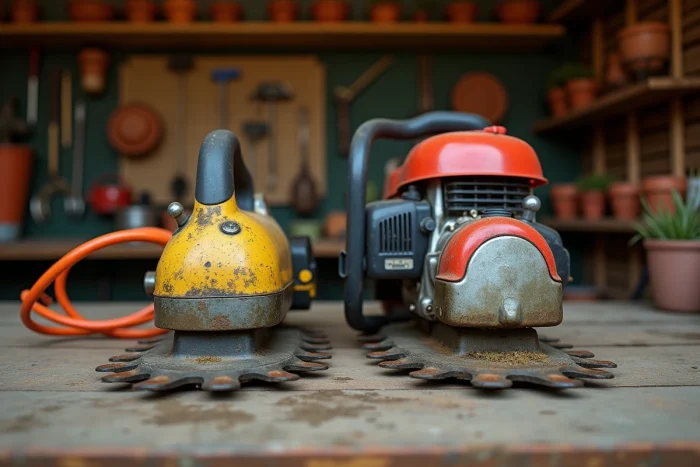
The debate between gas and battery often boils down to autonomy. This overlooks the most significant criterion in residential areas: noise and local regulations.
Since 2022, many French municipalities have tightened municipal orders on the noise from gardening tools, with more restricted time slots and increased controls. A two-stroke gas engine operates at a noise level much higher than that of a battery brushcutter. In practice, this means fewer available time slots for work and a real risk of neighborhood conflict.
The battery also has another advantage that is rarely mentioned: the absence of low-frequency vibrations characteristic of combustion engines. During a prolonged brushcutting session, hand and forearm fatigue decreases significantly.
However, for a sloped area with woody vegetation (thick brambles, hazel shoots), gas power maintains the advantage of continuous torque without a drop in power at the end of the charge. The right decision depends on the actual nature of the vegetation, not just the surface area.
Anti-vibration systems and harnesses: the areas where manufacturers have evolved
Manufacturers have focused on their recent ranges on anti-vibration systems and adjustable harnesses. This is not a marketing argument: it is a direct response to feedback from professionals and intensive users.
A good anti-vibration system isolates the handle from the engine block using calibrated rubber mounts. The difference is felt from the first half-hour of use. On entry-level models, these mounts are often made of hard rubber, which is not very effective. In mid-range and high-end models, Husqvarna and Stihl incorporate more sophisticated devices that significantly reduce the transmission of vibrations to the hands.

The harness deserves as much attention as the engine. A simple shoulder harness is suitable for quick touch-ups of edges. For sustained brushcutting, a double harness with a central suspension hook distributes the load across both shoulders and the hips, preventing back pain and improving the lateral maneuverability of the machine.
- Simple harness: suitable for lightweight trimmers and sessions of less than half an hour.
- Standard double harness: recommended as soon as the machine exceeds an average weight, or for regular sessions.
- Forestry harness with lumbar support: reserved for high-torque brushcutters used on dense or sloped vegetation.
Engine displacement, voltage, and torque: reading specifications without error
On a gas brushcutter, displacement alone does not tell the whole story. Two engines with the same displacement can deliver very different torque depending on the crankshaft design and operating speed. We observe that recent stratified engines offer better torque at low speeds, making it easier to cut through wet or fibrous vegetation without stalling the machine.
On a battery brushcutter, the nominal voltage (36 V, 40 V, 56 V) gives an indication of the available power, but it is the battery capacity in amp-hours that determines the actual autonomy. A high-voltage battery paired with low capacity drains quickly under load. Always check both parameters together.
- Two-stroke gas engine: lightweight, high torque, regular maintenance of the carburetor and air filter.
- Four-stroke gas engine: quieter, reduced consumption, but heavier at equal displacement.
- Lithium-ion battery: no engine maintenance, low noise, variable autonomy depending on capacity and cutting intensity.
One last technical point often overlooked: the diameter of the drive shaft. A small-diameter shaft on a powerful machine causes flexing that prematurely wears the angle gearbox bearings. Check the consistency between the advertised power and the sizing of the transmission.
Choosing a brushcutter commits you for several seasons. Focus your attention on the compatibility between the cutting head, the motorization, and your actual terrain, rather than just the power rating. A model well-suited to the local vegetation, equipped with a proper harness and recent safety accessories, transforms a chore into a controlled task.