A handball club that receives its new nets in September and finds that they do not fit the posts of the municipal gymnasium: this situation is common, and it costs time, budget, and goodwill. Properly equipping a club or community with sports equipment is not just about browsing a catalog. It involves compatibility with existing facilities, standards to be met, and choices that commit for several seasons.
Standards and regulatory constraints on sports equipment for communities
When a community installs a city stadium or motor skills structures in a schoolyard, it does not operate under the same regulatory category as a club that buys vests. Structures intended for children fall under the EN 1176 and EN 1177 standards, which govern impact resistance and ground shock-absorbing zones.
Fitness equipment available for public use follows the EN 16630 standard. Confusing these two references exposes the community in case of an accident. Therefore, the choice of equipment begins with the precise identification of the target audience and the usage context.
Opening a sports facility to the public outside of school hours (evenings, weekends) transforms the community into an operator. It must then organize regular maintenance, traceability of inspections, and display safety instructions. These obligations condition the type of equipment to prioritize: robust equipment, easy to inspect, and whose wear parts can be replaced without heavy intervention.
For clubs and communities looking to centralize their purchases of sports equipment (accessories, textiles, field equipment), a comprehensive overview can be found at https://www.france-sports.fr/, covering everything from football to badminton and climbing.
Collective sports equipment: football, handball, badminton, and beyond
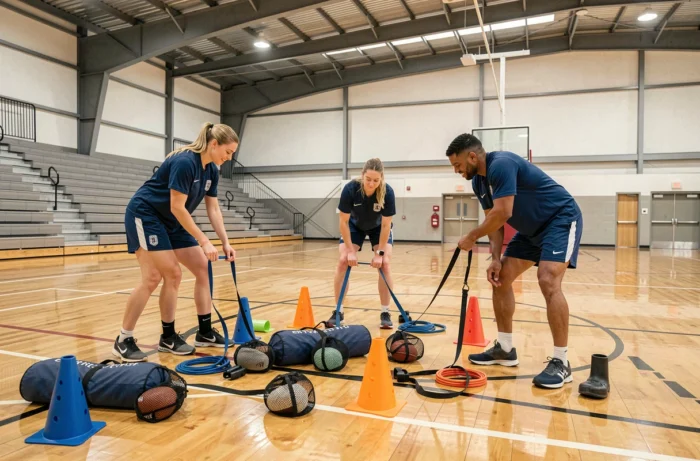
Field equipment forms the foundation of any collective sports club. Balls, cones, vests, nets, posts: these products may seem simple, but their durability varies greatly from one supplier to another.
A handball used three times a week in a gym lasts only one season if the covering is low quality. For outdoor football, opinions vary on this point, but most clubs find that a decent training ball lasts between six and ten months of intensive use.
Badminton and volleyball share a common constraint: the quality of the nets and ground anchoring systems. A poorly anchored post in a multipurpose gym (shared between handball, badminton, and climbing) eventually damages the flooring. It is recommended to check the compatibility of the anchoring sockets before placing any order.
Sports textiles and customization for clubs
Textiles often represent the first visible budget item for a club. Jerseys, shorts, tracksuits: beyond aesthetics, the fabric weight and type of sublimation determine the longevity of the garment.
A sublimated jersey withstands repeated washes better than a printed jersey because the ink penetrates the fiber instead of remaining on the surface. For a club that outfits multiple age categories, this difference translates into less frequent renewal.
- Check the minimum fabric weight: a fabric that is too light will deform after a few matches
- Favor sublimation for competition jerseys, while printing remains suitable for training
- Order a batch of replacement pieces (common sizes) with the initial order to avoid shortages during the season
Stadium layout and outdoor equipment for communities
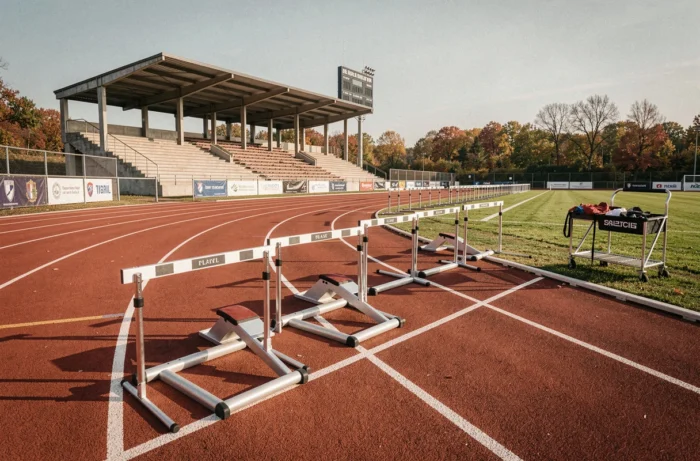
Outdoor layout goes beyond simply laying down a field. A city stadium, for example, involves work on the ground surface, fencing, lighting, and sometimes the integration of bleachers or storage for equipment.
Gyms and sports complexes larger than 1,000 m² are subject to the Eco Energy Tertiary scheme, with energy consumption reduction targets to be met by 2030, then 2040, and 2050. This means that the choice of lighting (LED versus halogen), heating systems, and ventilation is now an integral part of a community’s sports equipment.
It is no longer possible to separate the purchase of field equipment from the energy performance of the building that houses it. A club investing in electronic scoreboards or a sound system must factor these consumptions into the overall assessment of the installation.
Renovation versus replacement: the carbon arbitration
The temptation to demolish an aging facility to rebuild anew faces an environmental reality. Renovating an old sports facility can represent about half the carbon emissions of a demolition-reconstruction. For a community subject to ecological transition objectives, this arbitration weighs heavily in the decision.
Renovation also applies to small equipment: refurbishing badminton posts, replacing nets rather than the entire system, or renovating an existing climbing wall instead of installing a new one.
Transport, storage, and daily management of sports equipment
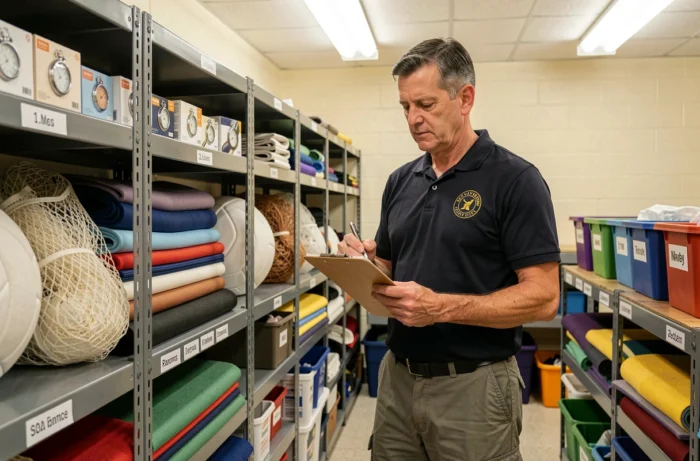
A gym shared between several clubs and school schedules requires rigorous organization of storage. Transport carts for balls, protective covers for mats, and wall-mounted systems for climbing equipment are not secondary accessories.
- Lockable ball carts to limit losses between time slots
- Wall storage for racket sports (badminton, table tennis) to free up floor space
- Labeled storage bins by discipline, facilitating inventory at the end of the season
A well-thought-out storage system reduces breakage and conflicts between users. When three associations share the same gym, knowing where each set of vests or each batch of rackets is located avoids tensions and duplicate purchases.
The choice of sports equipment for a club or community is determined as much by the catalog as by the precise knowledge of its facilities, regulatory obligations, and sharing constraints. A good purchase is one that lasts three seasons without complaint, not one that shines on the product sheet.