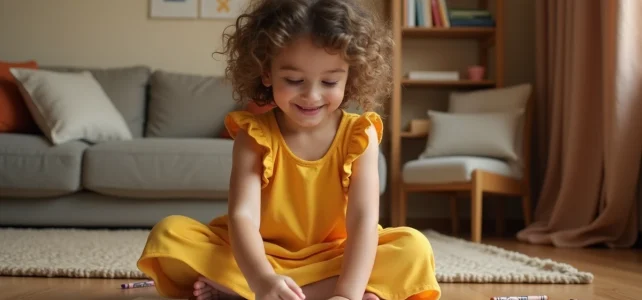
A child’s development does not solely take place at school or during structured activities. A large part of their growth is built in the micro-moments of daily life: the way we respond to anger, the time allowed to explore a game alone, the consistency of a bedtime routine.
Recent recommendations from the WHO and the High Authority of Health converge on the same observation: real interactions, sleep, and emotional management form the foundation of well-being from a very young age.
Child Sleep and Emotional Regulation: An Underestimated Link by Parents
Nutrition and physical activity dominate the attention in terms of child health. However, sleep is equally important for a child’s balance. INSERM and the High Authority of Health remind us that insufficient or irregular sleep leads to irritability and attention disorders in children, with direct repercussions on their motivation and sense of competence, both at home and at school.
The issue is not limited to duration. The regularity of the rhythm is just as important, if not more so. A child who goes to bed at 8 PM on weekdays and at 10:30 PM on weekends experiences a shift comparable to a mini-jetlag. Their biological clock struggles to readjust, which affects the quality of deep sleep, where learning is consolidated.
Several recent prevention programs in France offer simple levers: exposure to natural light in the morning, a stable bedtime routine (the same sequence of actions every evening), and especially a reduction of screens in the hour leading up to bedtime. These adjustments require neither budget nor expertise, but a consistency that families may find difficult to establish when they want to discover child resources on Allo Papa to structure their daily approach.
Screens and Social Media: What Recent Data Shows About Children’s Development
Screen exposure is the subject of a heated debate, but recent data points in a fairly clear direction for younger children. The WHO and UNICEF now recommend very strict limits before the age of five, emphasizing the substitution with free play and verbal exchanges to support the social-emotional development of the child.
Among pre-teens, studies link regular exposure to social media with decreased well-being, more depressive symptoms, and increased social anxiety, particularly among girls. The main identified mechanism involves social comparison and the risk of cyberbullying.
However, field feedback diverges on this point: a controlled, time-limited use shared with an adult does not produce the same effects as unrestricted and solitary access. The nuance lies less in the total screen time than in the context of use.
What to Replace Screen Time With, Specifically
The recommendation to “reduce screens” remains vague if it is not accompanied by practical alternatives. Here are some suggestions that have proven effective according to family feedback and prevention programs:
- Unstructured free play (building, modeling clay, drawing without instructions) develops concentration and creativity much more than an educational app on a tablet.
- Verbal exchanges during daily tasks (cooking, shopping, tidying up) enrich vocabulary and strengthen the parent-child bond without adding an extra activity to the schedule.
- Aged-appropriate board games work on emotional management (frustration from losing, patience in waiting for one’s turn) in a structured setting.
Autonomy and Self-Confidence: Supporting Without Directing
The Montessori pedagogy popularized the idea that children learn better by doing things themselves. The concept of absorbent mind between zero and two years describes a mechanism where the child acquires skills through observation and experimentation, provided their environment allows it.
Encouraging autonomy does not mean leaving the child without a framework. It is about calibrating the help provided to the right level. A three-year-old trying to dress themselves does not need someone to do it for them: they need accessible clothes, enough time, and an adult available in case of a real blockage.
Positive Education in the Face of Daily Limits
The Triple P program, whose effectiveness has been the subject of over 130 international studies according to its creators, offers a structured approach to positive parenting. Among its principles: setting clear limits without resorting to punishment, recognizing desired behaviors rather than sanctioning deviations, and maintaining realistic expectations based on age.
In practice, consistently applying these principles remains a challenge. A parent tired after a day’s work does not react the same way as a rested parent. The available data do not allow us to conclude that a single educational method suits all families. The challenge is rather to identify two or three sustainable practices over time.
Child Participation in Family Decisions: An Underutilized Lever for Growth
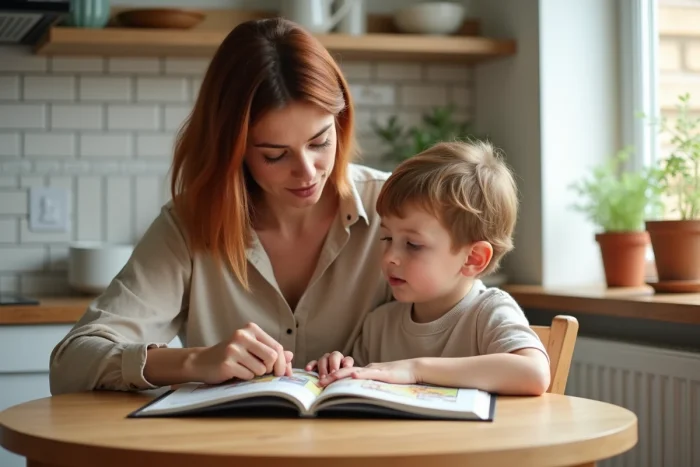
Several recent international recommendations place the active participation of the child in decisions that concern them as a protective factor for their development. This does not mean consulting them on the menu for every meal, but giving them a voice in choices within their reach.
Choosing between two activities on Wednesday, deciding the order of evening tasks, proposing an idea for a weekend outing: these decision-making spaces, even modest ones, strengthen the sense of competence and self-confidence. The child learns that their opinion matters, which directly nourishes their self-esteem.
- Before the age of four, offering two simple options is sufficient (which book to read, which fruit for snack).
- Between five and eight years, the child can participate in organizing their routine (order of homework, choice of extracurricular activity).
- After eight years, family discussions about common rules (bedtime on weekends, screen time management) become possible and educational.
Some concrete adjustments, repeated regularly, carry the essence of a child’s growth: protected sleep, regulated screens, measured autonomy. The difficulty is not knowing what to do, but maintaining these few guidelines over time, with the real constraints of family daily life.